The Missing Link: Who Connects Your Business Processes to Your Technology?
Imagine an employee contacts a software vendor because a business process isn't working as efficiently as it should.
The employee explains the problem. The vendor asks for technical requirements. The employee doesn't know how to answer.
The conversation goes back and forth, but neither side seems to be getting closer to a solution.
Sound familiar?
For organizations without internal IT expertise, this situation can be particularly challenging.
Employees understand what they need to accomplish, but they may not know how their applications are configured, what functionality is available, or whether different systems can work together.
Vendors understand their products, but they may not have a complete picture of the organization's workflows, operational priorities, or other technology dependencies.
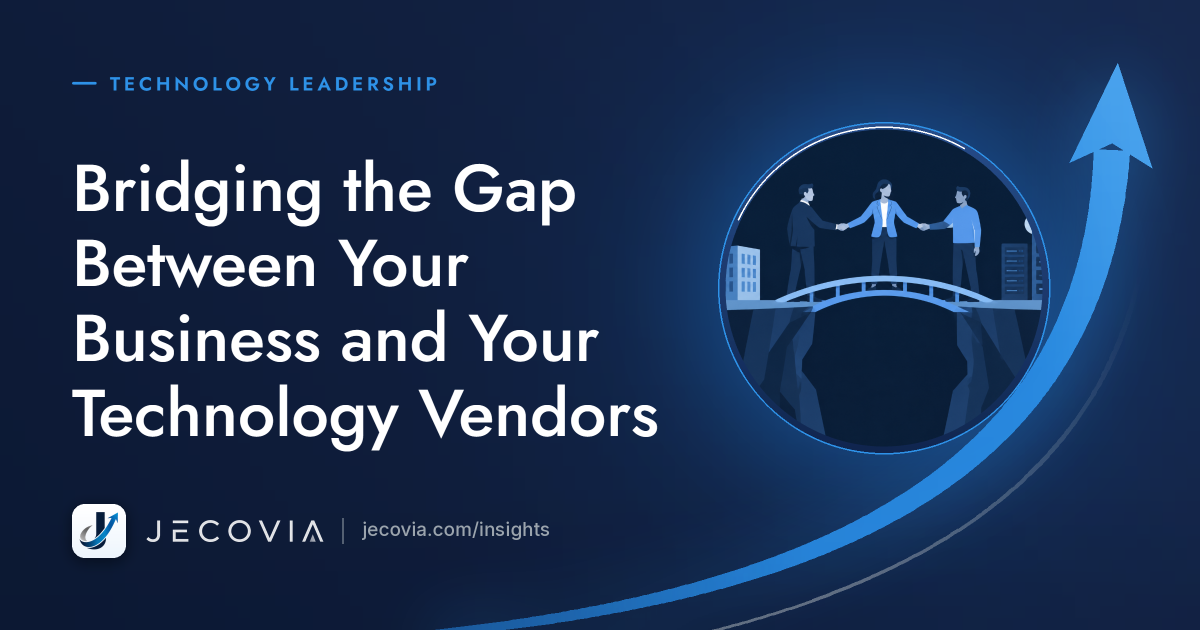
The challenge isn't necessarily a lack of knowledge on either side. It's the absence of someone who can connect the two.
When business problems meet technical questions
Employees often know precisely which processes are slowing them down. What they may not know is whether existing technology can solve them—or how to structure the solution correctly.
Consider an operations team that enters customer information into both a CRM and an ERP. Over time, staff notice discrepancies: a customer's name is spelled differently in one system, or an address is outdated in the other. Which system is the actual "source of truth"?
These inconsistencies can lead to billing errors, delayed orders, additional administrative work, and unreliable reporting—all of which affect daily operations.
Employees recognize the duplicate effort and data errors but assume they're unavoidable because the systems aren't connected.
In reality, those applications may support an automated integration. But simply transferring data doesn't fix the underlying problem—it can just automate the mistakes.
Determining how data should flow requires identifying which system owns each data element, mapping fields between applications, handling conflicting updates, and establishing data validation and error-handling procedures.
Each vendor may have a different perspective on where customer information should be maintained. The CRM vendor may recommend managing it within the CRM, while the ERP vendor may suggest its own application. Both recommendations may have merit, but determining which system should be authoritative for specific information requires evaluating how the organization's business processes and applications work together.
A successful integration requires clear data governance rules, coordinated technical requirements between vendors, and a solution designed around the organization's actual business workflows.
Identifying an inefficient process is the first step. Connecting the business need with independent technical expertise is what moves a solution forward.
Translating business needs into requirements vendors can act on
An employee tells a software vendor, "Our approval process takes too long. We need a better way to manage it."
The vendor may ask: Who needs to approve? Are approval levels based on transaction amounts? What happens when an approver is unavailable?
Employees understand the problem but may not know how to translate their needs into technical requirements.
Without clearly defined requirements, an organization risks automating an inefficient process rather than improving it.
Closing this gap requires evaluating the workflow, defining clear business and technical requirements, and working with the vendor to assess available functionality, configuration options, and proposed solutions.
The goal isn't simply to implement a technical solution. It's to make sure the solution addresses the right business problem.
Your vendors know their products. Who represents your interests?
Technology vendors provide valuable expertise, but their recommendations generally focus on the products and services they support.
A software vendor may recommend an additional module. An integration provider may propose custom development. An IT support company may suggest upgrading infrastructure.
Any of these recommendations could be appropriate. But who determines what's best for your organization?
Could existing functionality accomplish the same objective? How would the proposed solution affect other systems? What are the costs and ongoing support requirements?
Evaluating vendor recommendations requires looking beyond individual products to consider the organization's broader technology environment, operational priorities, and budget.
An independent technical advisor can clarify proposals, identify technical dependencies, and coordinate discussions between vendors to ensure everyone understands their responsibilities.
The objective isn't to replace existing vendors, but to provide an independent technical perspective that helps the organization make informed decisions.
Your vendors should be part of the solution. But your organization's needs should drive the decisions.
Five questions to ask about your vendor relationships
You don't need to understand every technical detail to recognize when your organization could benefit from additional expertise.
Start by asking:
- Who translates our business needs into technical requirements?
- Do we understand the solutions our vendors recommend, or are we relying entirely on their recommendations?
- Who evaluates how proposed changes might affect our other systems?
- Who coordinates communication and responsibilities when multiple vendors are involved?
- Who ensures our technology decisions align with our business priorities and budget?
If these questions are difficult to answer, your organization may be missing an important technical perspective.
You don't need an IT department to bridge the gap
Not every organization needs a full-time CIO, technology director, or dedicated IT department. But every organization that relies on technology needs access to the right technical expertise.
That's where Jecovia comes in.
As an independent technology advisor, Jecovia works on your behalf to translate business needs into technical requirements, evaluate vendor recommendations, and coordinate solutions that align with your organization's priorities.
We don't replace your existing vendors. We help you work more effectively with them, providing the technical guidance and independent perspective your organization may lack internally.
Your employees understand your business. Your vendors understand their technology. Jecovia helps bring those perspectives together.
Struggling to translate business needs into technical solutions or navigate vendor recommendations? Contact Jecovia to discover how we can help.
Want an independent view of your technology?
Start with a free discovery call. We'll talk through your systems, vendors and priorities, with no software to sell you.
Book a free discovery callJecovia
Independent technology consultancy
Jecovia is an independent technology consultancy. We take no vendor commissions.
Follow Jecovia on LinkedIn